
Meanwhile, in French Guiana, Europe’s Ariane 6 rocket has launched two dedicated missions for Amazon Leo, each with 32 satellites. Amazon has shipped the next batch of satellites to French Guiana for the next Ariane 6 launch, which will debut an upgrade for higher payload capacity.
Amazon originally bought launches on every available large Western rocket except SpaceX’s Falcon 9. The only rocket in Amazon’s stable of launchers with any flight history was ULA’s Atlas V, with a finite number of remaining launches due to its impending retirement. Delays with Vulcan, Ariane 6, and New Glenn were initially of little concern to Amazon, which was contending with its own issues scaling production of satellites in a factory in Kirkland, Washington. The situation changed last year, when Amazon’s satellite production outpaced the availability of rockets to put them into space.
Amazon retreated from the “everyone but SpaceX” strategy in 2023 after a shareholder lawsuit accused founder Jeff Bezos and the board of directors of breaching their “fiduciary duty” by not considering SpaceX as an option for launching Amazon Leo satellites. The plaintiffs in the lawsuit alleged Amazon didn’t consider the Falcon 9 due to an intense and personal rivalry between Bezos and SpaceX founder Elon Musk.
Amazon bowed to the allegations and announced a contract with SpaceX for three Falcon 9 launches, all of which flew last year. Amazon has scooped up 10 more Falcon 9 flights since then, but none have flown yet.
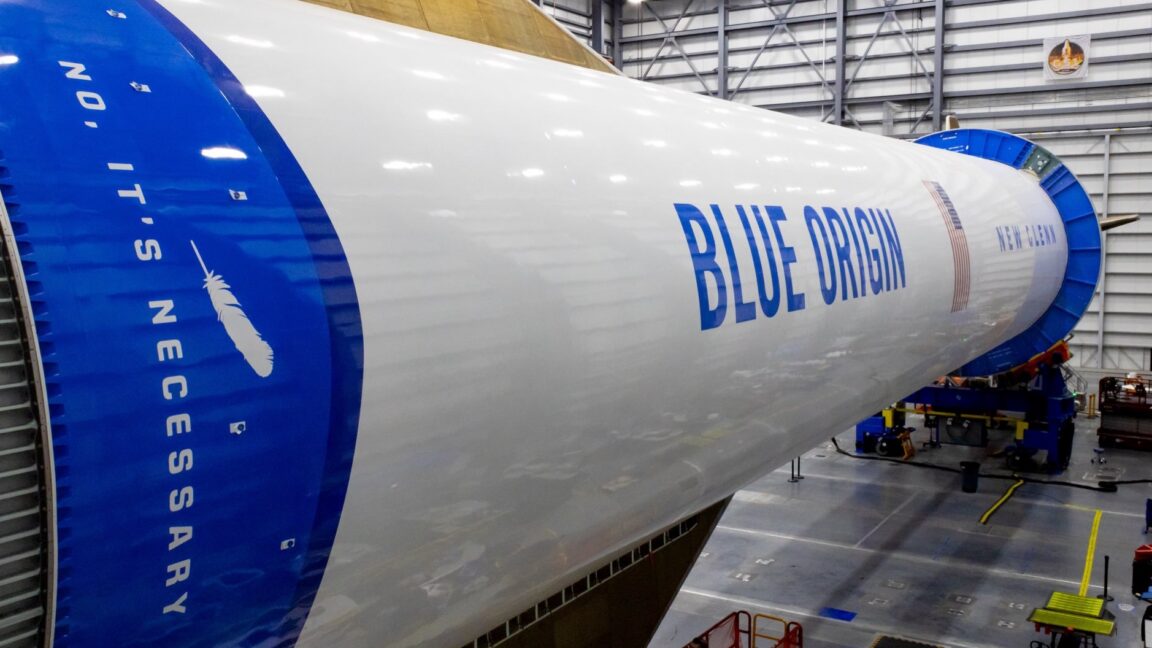
With Blue Origin’s New Glenn soon to fly its first mission for Amazon, Arianespace’s Ariane 6 on stable footing, and the prospect of more Falcon 9 launches on the horizon, Amazon may have turned a corner in solving its rocket conundrum.
If it has, a well-funded competitor to SpaceX’s Starlink service, long dominant in the satellite broadband market, may finally be at hand. Still, Starlink has the advantage of launching satellites cheaply and reliably on Falcon 9. SpaceX’s internal costs for a Falcon 9 launch are thought to be close to $15 million, one-fifth of the $74 million SpaceX charges external customers like Amazon for a dedicated flight.