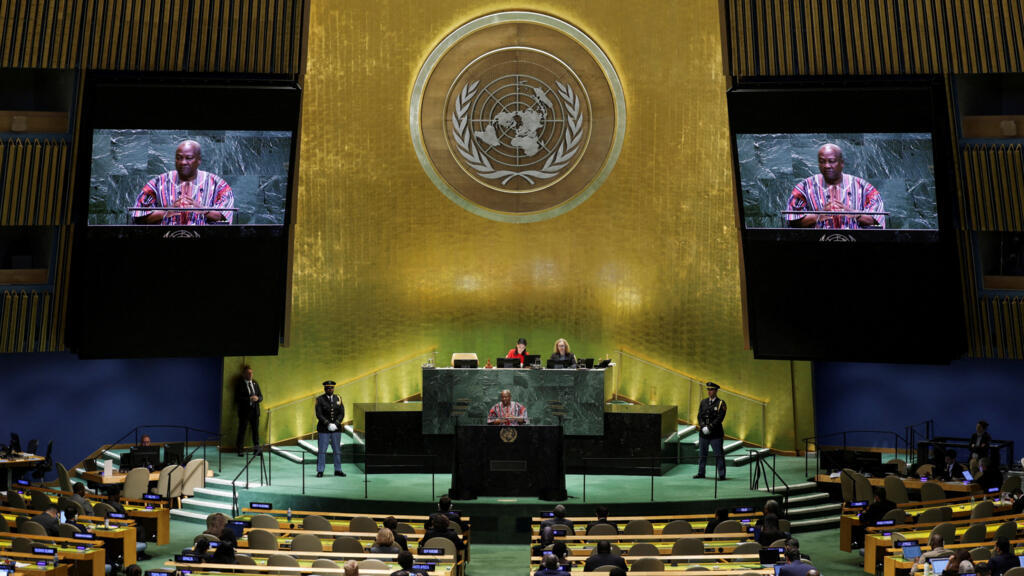

The United Nations General Assembly on Wednesday adopted a resolution reinforcing states’ obligations to combat climate change, a long-awaited move toned down under pressure from major greenhouse gas emitters.
The General Assembly, driven by the Pacific island nation of Vanuatu, previously asked the International Court of Justice for an advisory opinion on states’ responsibility to honor their climate commitments.
The opinion issued last summer exceeded the expectations of climate advocates, with the court ruling it was “unlawful” for countries to neglect their climate commitments, opening the door to “reparations” for affected countries.
“The states and peoples bearing the heaviest burden are very often those who contributed least to the problem,” said Vanuatu’s ambassador to the UN, Odo Tevi, ahead of the vote.
“We are aware that some would prefer this assembly to say less or nothing at all…the harm is real, and it is already here.”
The vote was 141 votes in favor and only eight against — uniting the United States, Russia and Iran which are all major gas and oil exporters and sought to strike down the initiative.
Read moreProtections for emperor penguins in focus as Antarctica talks start in Japan
To add momentum to the ICJ’s non-binding opinion, on which courts around the world can nevertheless rely, Vanuatu presented a draft resolution in January aimed at putting it into practice.
But the text was altered significantly after negotiations among states, with climate change taking a back seat to national security or industrial interests in many countries.
The resolution welcomed the ICJ opinion “as an authoritative contribution to the clarification of existing international law” and calls on states to “comply with their respective obligations” to protect the climate.
UN Secretary-General Antonio Guterres praised the move in a statement Wednesday, commending the leadership of island leaders and “the young people whose moral clarity helped bring the world to this moment.”
“This is a powerful affirmation of international law, climate justice, science, and the responsibility of states to protect people from the escalating climate crisis,” Guterres said.
No damage register
It also emphasizes the measures needed to keep global warming limited to 1.5C above pre-industrial levels, particularly “transitioning away from fossil fuels in energy systems.”
That would be in keeping with a goal adopted by nearly 200 countries during a global climate meeting in 2023.
However, the creation of an “International Register of Damage” to compile evidence of “damage, loss or injury attributable to climate change” vanished from the adopted text.
Read moreEurope hit by record heat, glacier loss and marine extremes per climate report
The biggest contributors to greenhouse gas emissions routinely oppose any mechanism that could force them to pay reparations to victims of climate disruption.
The resolution nonetheless states that according to the ICJ, a state in violation of its climate obligations may be required to pay “full reparation to injured states.”
Washington’s representative to the meeting, Tammy Bruce, said “the resolution includes inappropriate political demands relating to fossil fuels and on other climate topics.”
Climate advocates now hope the idea of a damage registry will be reconsidered, bolstered by a report from the UN chief.
“This must be a turning point in accountability for damaging the climate,” said Vishal Prasad, Director at Pacific Islands Students Fighting Climate Change (PISFCC), the NGO that started the push championed by Vanuatu.
“Communities on the frontlines, like in the Pacific, have been waiting far too long and continue to pay too high a price for the actions of others.”
Oil-producing Saudi Arabia and Kuwait sought to make amendments that removed some references cementing the ICJ’s opinion as a guiding framework for climate action — which Vanuatu said weakened the effort.
They also used procedural tactics to delay the vote.
(FRANCE 24 with AFP)