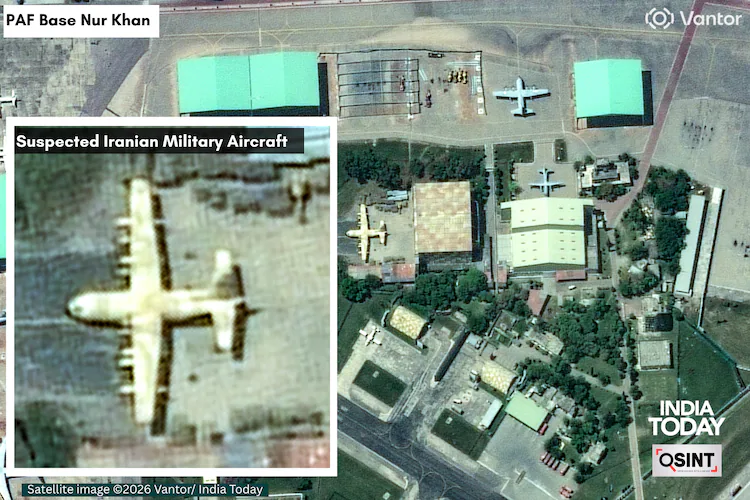
Commercial high-resolution satellite imagery reviewed ’s Open-linked aircraft may have been parked at Pakistan’s Nur Khan airbase in Rawalpindi. The airbase has been undergoing fresh construction intended to reduce satellite visibility of military assets, almost a year after Indian strikes.

Imagery sourced from a US-based space intelligence firm, Vantor, shows a military aircraft matching the design of a C130 transport plane stationed at Pakistan’s sensitive VVIP airbase.
Earlier, CBS News cited US officials as saying the aircraft was believed to be a reconnaissance and intelligence-gathering variant of the C130 platform.
Two additional aircraft resembling Iranian Meraj Air planes are also visible in imagery captured on April 25. One of these aircraft was likely used by Iranian Foreign Minister Abbas Araghchi during his second visit to Islamabad. The reasons for the other two aircraft parked at the base remain unclear, with US lawmakers questioning the developments.
Painted in desert or sand camouflage, the C-130-type aircraft appears to have arrived during the Iranian delegation’s visit on April 12 and has remained at the base since then, according to satellite imagery and social media footage reviewed .
Nur Khan airbase hosts the Pakistan Air Force’s No. 12 VIP Squadron, nicknamed the “Burraqs”. The unit is responsible for transporting Pakistan’s top leadership, including the President, Prime Minister, service chiefs and cabinet ministers.
Before the Islamic Revolution, the Imperial Iranian Air Force operated older variants of the C130 aircraft. Several of these platforms are believed to have remained in Iranian service, although sanctions may have limited major upgrades.
Pakistan also has a history of operating similar aircraft. However, camouflaged C130s have not appeared in publicly available imagery from Nur Khan for years. Historical imagery from May 2011 available on Google Earth shows a camouflaged C130 parked at the same location within the base, but no such aircraft has been visible there in recent years. Analysts also noted differences in the camouflage pattern between the earlier Pakistani aircraft and the aircraft currently visible at the base. The current paint scheme more closely resembles those seen on Iranian Air Force platforms.
Both US and Iranian delegations visited Islamabad on April 11 and 12, while Abbas Araghchi returned to the Pakistani capital on April 24 for a second visit.
Earlier, open-n-linked aircraft approaching Islamabad on April 11. The C130 aircraft, however, did not broadcast public flight signals. Two publicly tracked Airbus A320 aircraft belonging to Iran-based Meraj Airlines, using the call signs Iran04 and Iran05, departed after the summit. However, two other aircraft, including a Bombardier CL-600 linked to Iran’s Pouya Air, have not appeared on publicly available flight-tracking platforms since then.
Imagery released during the early days of the Iran conflict had earlier shown multiple Iranian C130 aircraft destroyed during US-Israeli strikes at Iran’s Shiraz airbase.
NEW HANGARS AFTER OPERATION SINDOOR
Fresh satellite imagery also indicates significant reconstruction activity at Nur Khan airbase nearly a year after it was targeted by India during Operation Sindoor.
A facility believed to be a Command and Control centre, visibly damaged during the Indian strikes, appears to have been demolished and replaced with a brand-new structure. The imagery also shows four newly constructed hangars at the base, likely intended to shield aircraft and sensitive assets from satellite observation. Imagery captured on April 25 further suggests that construction of additional similar structures is still underway.
– Ends