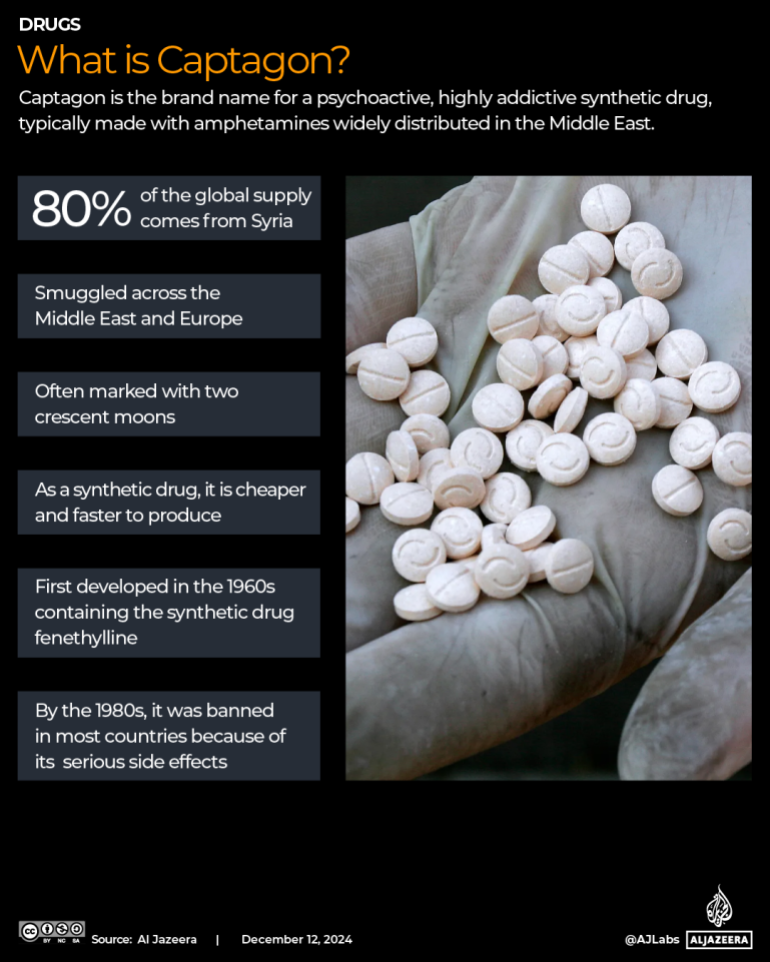
Jordanian fighter jets struck what they described as “factories and laboratories” for narcotics in southern Syria on Sunday, highlighting the emergence of Suwayda province as a key hub for the production of Captagon, a highly addictive amphetamine.
While the multibillion-dollar Captagon industry was once synonymous with forces linked to the government of former President Bashar al-Assad, recent investigations and military operations, dubbed “Operation Jordanian Deterrence”, show the trade has found a new haven in the restive southern province.
The developments point to an emerging axis between the new Syrian government and Jordan to dismantle the burgeoning drug infrastructure in Suwayda, a southern province that borders Jordan, to halt the spread of Captagon.
Here is a breakdown of why the Druze-majority province has become a regional hub for the production and distribution of the drug.
The shift to a Captagon hub
The recent air attacks specifically targeted sites associated with the “National Guard”, a militia loyal to Sheikh Hikmat al-Hijri, an influential figure within Syria’s Druze minority, an offshoot of Shia Islam. While the drug trade was historically linked to Iranian-aligned armed groups in neighbouring Deraa, recent reports indicate a major shift towards Suwayda, which has remained largely outside government control since the fall of al-Assad in December 2024.
Clashes between the Syrian military and Druze militias, backed by Israel, in 2025, had further entrenched Suwayda’s isolation from the Syrian state, with the National Guard, the group in the province most strongly opposed to new President Ahmed Al-Sharaa, becoming the dominant force there.
According to a report by investigative outlet Forbidden Stories, this situation has allowed Suwayda to become a “hotspot” for the Captagon trade with elements linked to the National Guard not only accused of establishing drug manufacturing labs and warehouses within the province, but also operating smuggling rings beyond Syria’s borders.
Why Jordan is acting now
For Jordan, the emergence of Suwayda as a Captagon manufacturing hub has become a national emergency, with the drug becoming increasingly prevalent in the kingdom. Colonel Abdullah al-Sarhan, a retired Jordanian pilot, noted that Sunday’s “preemptive” strikes were a necessary action, given that the trafficking methods of drug smugglers had evolved significantly. “The best defence is a good offence,” al-Sarhan told Al Jazeera Arabic.
He argued that air strikes were required by Jordan to curb the drug trade, as Captagon labs in Suwayda are often shielded by difficult terrain with criminal groups in Syria using advanced techniques, such as drones, to deliver the contraband over the border.
A Jordanian government presence of drug-production facilities on its doorstep but stressed that Sunday’s operation was conducted in full coordination with the new Syrian authorities to preserve the national security of both nations.
The new Damascus-Amman axis
The air strikes align with the objectives of Syria’s new leadership under al-Sharaa, whose government is determined to dismantle the National Guard’s autonomy, which it views as a threat to state sovereignty. Alleged drug and weapon smuggling from southern Syria to Jordan is also considered to be a threat to the kingdom’s stability.
Major-General Mamoun Abu Nowar, a retired Jordanian military analyst, told Al Jazeera that the kingdom’s actions send a clear message to elements operating in southern Syria. “Jordanian national security is inextricably linked to Syrian national security,” Abu Nowar said. He added that the strikes serve as a deterrent not only to drug cartels but also to external actors who might seek to take advantage of the power struggle between the central government in Damascus and the Druze factions.
“It is a message to those within Suwayda cooperating with Israel and to Israel itself: do not attempt any future projects on our borders. Jordan will not hesitate to strike these nests,” Abu Nowar said.
The Israel and US factor
The conflict over Suwayda’s drug trade has the potential to draw in broader regional powers. Israeli officials have previously sought to position themselves as protectors of Syria’s Druze community, and carried out attacks on government forces during clashes in Suwayda between the military and armed groups linked to al-Hijri.
In early March 2025, Prime Minister Benjamin Netanyahu threatened to advance the Israeli military to the outskirts of Damascus, using the spurious claim of protecting Syria’s religious minorities.
However, the United States has signalled its opposition to such escalations and in July 2025, the US State Department publicly criticised Israeli air strikes in southern Syria, calling for diplomatic engagement and urging the Syrian government to lead the path towards stability. This is a position that aligns with the current efforts by both Amman and Damascus to consolidate border security and eradicate the presence of Captagon from Syria, which has expanded criminal activity across the region.
What comes next?
The situation in Suwayda remains highly volatile, with much of the province still outside government control and periodic clashes along its periphery.
The Syrian government and Jordan are determined to dismantle the National Guard’s alleged illicit economic lifelines, while there is little incentive for criminal elements to give up this lucrative trade without a fight. The battle for the control of Suwayda is now a crucial test for the stability of post-Assad Syria that has broader implications beyond its borders.