The Bharatiya Janata Party swept the West Bengal Assembly elections and ended Mamata Banerjee’s 15-year rule.
What factors shaped this outcome? The Election Commission’s Special Intensive Revision of electoral rolls emerged as one of the most contentious issues in the run-up to the polls.

It was touted by officials as a routine exercise but criticised by Opposition parties. But to what extent did this revision, which resulted in the deletion of thousands of names, influence the final verdict?
In numbers
- The BJP secured nearly 46 per cent of the votes, compared to the TMC’s 41 per cent
- The BJP won 207 seats, while the TMC was reduced to 80
- The BJP won 26 seats with victory margins between 20 and 30 per cent
- In another 116 seats, its margin ranged between 10 and 20 per cent
- Compared to the 2024 Lok Sabha elections, the state’s electoral rolls shrank by nearly 10 per cent in the Assembly polls
The big picture
In the months leading up to West Bengal’s Assembly polls, the Election Commission of India removed roughly one in 10 voters from the state’s electoral rolls. Trinamool Congress leader Mamata Banerjee alleged that the exercise disproportionately targeted her party’s supporters.
A seat-by-seat analysis suggests a more complex picture: both claims hold elements of truth, but neither fully explains the result.
Seats held by the TMC in 2021 saw a higher average reduction in voters under the SIR than those held by the BJP by about 1.7 percentage points. But paradoxically, the constituencies that saw the deepest cuts were also those where the TMC performed best in 2026.
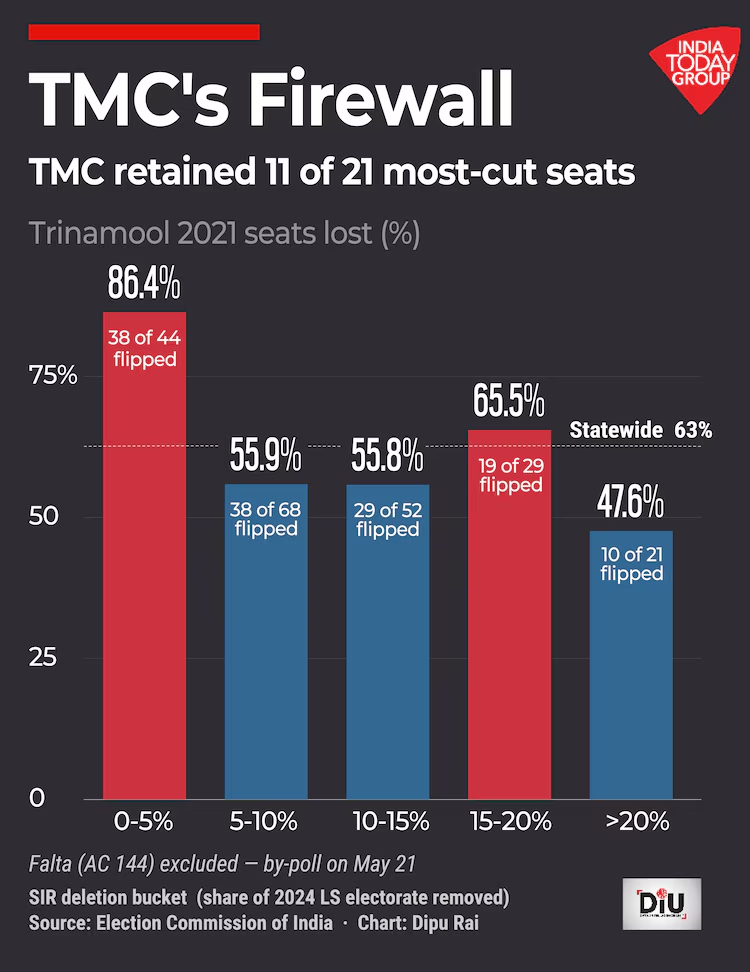
Among the 21 seats where more than 20 per cent of voters were removed, fewer than half flipped to the BJP, well below the party’s statewide strike rate of 63 per cent.
Grouped by deletion levels, the TMC’s 2021 seats show an inverse pattern: constituencies with the smallest cuts (0–5 per cent) flipped most frequently (86 per cent of 44 seats), while those with the largest cuts (over 20 per cent) flipped the least (10 of 21 seats).
The SIR reductions were unevenly distributed. Constituencies won by the TMC in 2021 lost an average of 28,019 voters each, compared to 23,834 in BJP-held seats. Of the 20 constituencies with the largest deletions, 18 had elected Trinamool MLAs in 2021.
The Murshidabad and Maldah regions, where the TMC draws significant support from Bengali Muslim voters, accounted for a substantial share of these cuts.
Take Samserganj in Murshidabad district: more than 86,000 voters were removed, which is the highest in any constituency. Despite this, the TMC retained the seat, though its victory margin narrowed from 26,379 votes in 2021 to 7,587 in 2026.
If voter-roll deletions had decisively shaped outcomes, the most affected constituencies would be expected to flip at the highest rates. The data shows the opposite. In TMC-held seats with deletion rates below five per cent, about 86 per cent changed hands; in contrast, only 48 per cent of seats in the highest-deletion category (over 20 per cent) flipped.
Across categories, the relationship between deletions and electoral outcomes ran counter to a simple cause-and-effect narrative.
One interpretation is that the most heavily affected constituencies, such as Murshidabad, Maldah, and parts of Kolkata, are also Trinamool strongholds. Even large reductions in voter rolls may not translate into equivalent electoral losses if the remaining electorate continues to favour the incumbent. Another possibility is that the TMC’s losses were concentrated in areas where the SIR had limited impact.
Whether the TMC’s resilience in the most affected seats reflects organisational strength, voter loyalty, or the limits of electoral roll revisions as a political lever remains an open question.
What the chart reveals
The constituencies most affected by the revision were also those the TMC retained most effectively. If voter deletions had been decisive, losses would be expected to rise with the scale of cuts. Instead, they declined.
This pattern resembles a “firewall”: constituencies largely in Murshidabad, Maldah, and parts of Kolkata absorbed the deepest reductions in voter rolls but resisted the broader BJP surge.
This does not invalidate the TMC’s claim that deletions were concentrated in its strongholds; the data supports that contention. But on the narrower question of electoral impact, the evidence remains inconclusive.
Note: Falta in South 24 Parganas has been excluded from this analysis as it will go to a by-poll on May 21.
– Ends