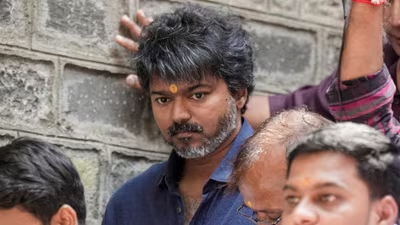
The deadly September 2025 Tamilaga Vettri Kazhagam (TVK) rally stampede failed to overshadow its chief’s, actor-turned-politician ‘Thalapathy’ Vijay, popularity as the party eyed a historic electoral victory in Tamil Nadu in its debut election.
<figure class="art
The counting of votes for Tamil Nadu assembly election 2026 began at 8 am, shortly after which trends emerged and so did the TVK as the single-largest party. Track ‘Thalapathy’ Vijay election result live here
According to Election Commission of India data at 4:30 pm, the TVK was ahead or leading in over 105 seats, while the ruling Dravida Munnetra Kazhagam (DMK) was struggling to make gains with a humble 58 leads.
The All India Anna Dravida Munnetra Kazhagam (ADMK) was ahead in 45 constituencies.
The September 2025 Karur stampede, which occurred during a massive gathering linked to Vijay’s political outreach, had briefly shifted focus from his political rise to concerns over intensity of fan-driven politics.
Over 40 people were killed and dozens were injured when supporters surged during the event.
Despite a campaign marred by memories of a deadly stampede, the Tamil Nadu projected results reflect Vijay’s massive fan-following turning the tide to TVK’s favour in a stunning show for a debutant party.
TVK positioned itself as a strong contender in Dravidian bastion Tamil Nadu with its manifesto which focused on key groups like women and unemployed graduates.
A monthly handout of ₹2,500 for every woman in Tamil Nadu, ₹10,000 for unemployed graduates, a waiver for cooperative crop loans and a ministry of artificial intelligence – Vijay’s TVK made a raft of promises aimed at the southern state’s women, its farmers, and the younger population in its manifesto.
Those promises appeared to click with Tamil Nadu’s voters.
A win in the works since 2009
Vijay’s win is the result of a carefully engineered political rise that has converted fan loyalty into a formidable electoral machine – a moment that has been in the making for years.
The actor, popularly known as ‘Thalapathy’, began restructuring his fan base as early as 2009, transforming it into the Vijay Makkal Iyakkam – a grassroots network that steadily built booth-level presence through welfare work and local engagement. This groundwork paid off in the 2021 local body elections, where the network demonstrated it could translate popularity into votes, not just crowds.
The actor’s political messaging also evolved alongside this organisational build-up. Public appearances increasingly focused on issues like unemployment, education, corruption and governance, resonating strongly with younger voters and urban aspirants.
By the time he formally launched TVK in 2024, Vijay had already positioned himself as a credible alternative to the entrenched MK Stalin-led DMK and the AIADMK, rejecting alliances and staking claim to a clean, independent mandate.
A decisive turning point came when Vijay announced his exit from films in December 2025, ending a three-decade career to fully commit to politics. Over the next few months, TVK expanded rapidly, building district and booth-level structures while refining its campaign narrative around accountability and systemic change.
His rise inevitably invites comparisons with MG Ramachandran, the last film star to sweep to power in 1977, though the context differs sharply. Where MGR rode a populist wave, Vijay’s surge has been driven by governance fatigue and generational aspirations. Unlike J Jayalalithaa, who inherited an existing political structure, Vijay has built his party from the ground up.
Welfare-heavy manifesto targets women, youth
The TVK manifesto also laid out ambitious plans for employment and education, including unemployment allowances for graduates, collateral-free loans up to ₹20 lakh for students, and stipends for skill training. A major push for job creation included a scheme to employ five lakh youth at the village level, alongside incentives for companies hiring local workers.
Farmers were promised cooperative loan waivers and legally guaranteed minimum support prices, while broader governance reforms included a Right to Service Act and a Citizen Privilege Card to streamline access to welfare schemes.
The party also pitched forward-looking ideas such as a dedicated ministry for artificial intelligence, signalling a blend of welfare politics with a development-oriented agenda.