
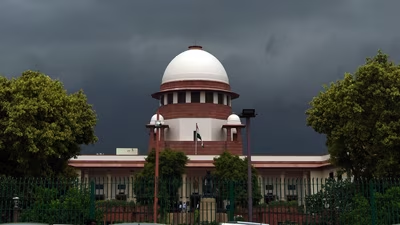
The Supreme Court on Wednesday expressed its displeasure over the state of affairs in national company law tribunals (NCLT) across the country, observing that gaps in infrastructure, manpower and supporting staff have been holding up approvals for resolution plans for years on end.
<figure class="art
A bench of justices JB Pardiwala and KV Viswanathan termed the situation “grim and dismal” after going through a report presented by the NCLT principal bench, New Delhi. The report showed 383 applications were pending across the country, awaiting approval of resolution plans, with the delay ranging from 48 days to 738 days.
“We take suo motu cognisance of the aforesaid in larger public interest. The issues need to be addressed on a war footing or else the purpose of enacting the Insolvency and Bankruptcy Code (IBC) would stand frustrated,” the bench said, directing the matter to be placed before Chief Justice of India (CJI) Surya Kant for assigning it to an appropriate bench.
Going through the report, the bench noted a serious manpower crunch across NCLT benches with a working strength of only 54 members (28 judicial and 26 technical) out of a sanctioned strength of 63. “There is acute shortage of members which is severely affecting the functioning of NCLT in a time-bound manner,” it observed.
The court also took exception to NCLT registrar being appointed on a contractual basis. “This is something unheard of,” it said.
The report also pointed out major infrastructural constraints that force the tribunal to sit for half a day. Even the staff assisting the benches are appointed on contractual basis and their salaries and other allowances have not been regularly paid, the report added.
“Do you expect an adjudicatory body handling cases of this nature to decide matters in such conditions,” the court remarked. “In some cases, the delay in grant of approvals of resolution plans is up to four years and in very few cases, interim orders are being passed.”

