New Delhi:
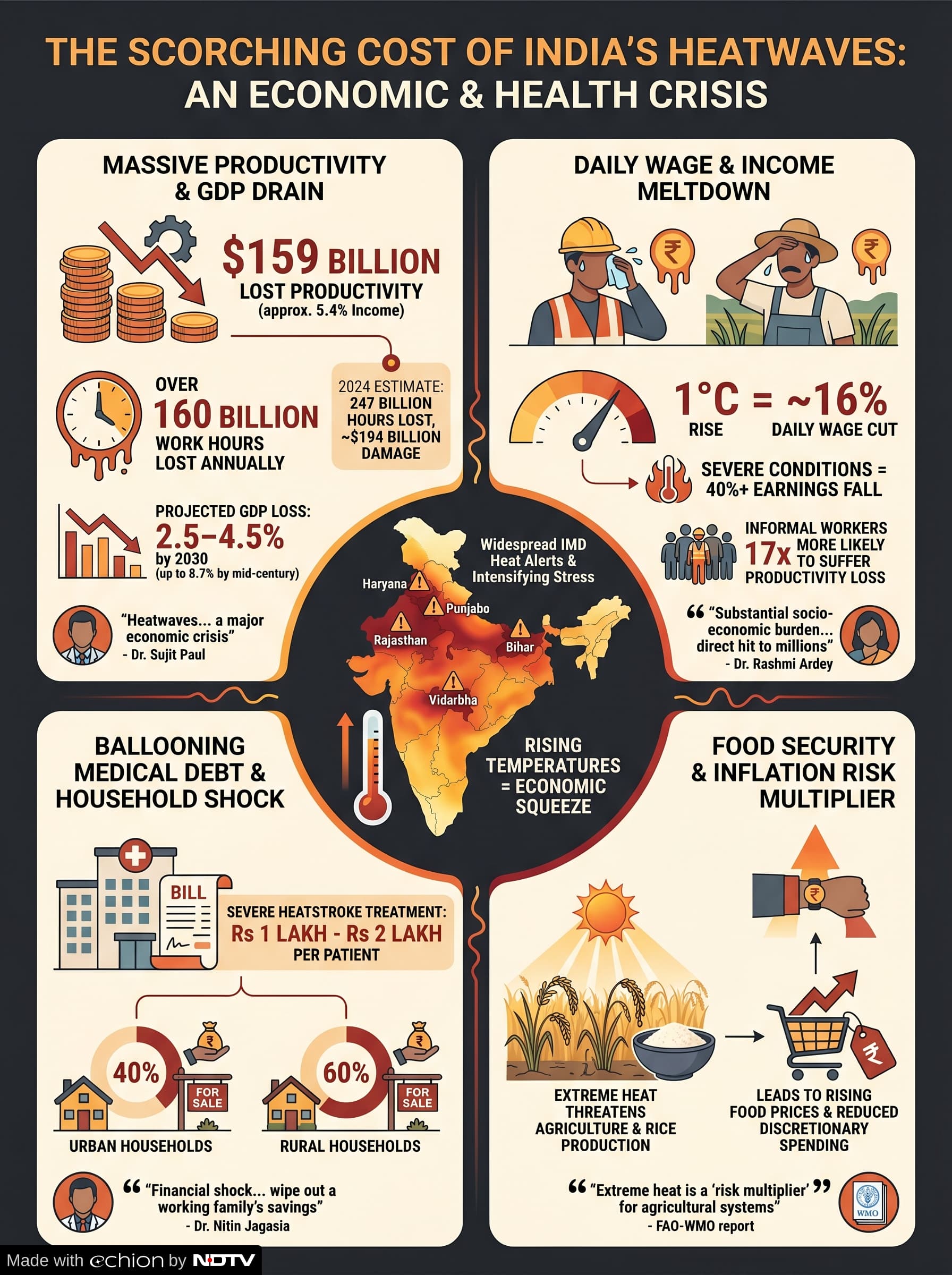
As the India Meteorological Department (IMD) issues widespread heatwave alerts across Haryana-Chandigarh-Delhi, Punjab, East Rajasthan, Bihar, Vidarbha (Maharashtra), Chhattisgarh and Jharkhand, economists and health experts are warning that the blistering heat will do more than sizzle temperatures — it will squeeze economic growth, cut productivity and balloon medical costs.
“Heatwaves in India are no longer just a health problem; they’re a major economic crisis,” says Dr Sujit Paul, Zota Healthcare Ltd. He points to analyses showing that extreme heat has already accounted for around $159 billion in lost productivity, roughly 5.4 per cent of India’s income, with over 160 billion work hours lost annually because workers are unable to operate at peak output.
He adds, “By the end of the decade, heatwaves could hurt India’s economy much more than anticipated, costing up to around 2.5-4.5 per cent of the country’s GDP.” Some estimates even suggest heat stress could cost India 8.7 per cent of GDP by mid-century without policy action.
Heat exposed sectors such as agriculture, construction and informal urban labour face the brunt. Outdoor workers, in particular, earn substantially less as they are forced to stop work during peak heat hours.
The Hidden Cost Of Heat
According to Dr Rashmi Ardey, Director Programme (Health), Smile Foundation, heat stress is now “imposing a substantial socio-economic burden through reduced labour productivity and income losses.” She notes that a 1-degree Celsius rise in temperature can lower daily wages by around 16 per cent, and in severe conditions, earnings can fall by 40 per cent or more. That’s a direct hit to millions of households that rely on daily wages.
Ardey’s observations resonate with global estimates suggesting heat stress could reduce total working hours by 2-3 per cent by 2030. This would be a significant dent in a labour-intensive economy such as India’s, where a large share of workers are employed outdoors.

Back in 2021-22, India lost an estimated 160-191 billion labour hours. This was equivalent to roughly 5.4-6.3 per cent of GDP — translating into hundreds of billions of dollars in lost output. According to studies, informal workers are up to 17 times more likely to suffer productivity losses due to heat exposure.
Medical Bills Add Fuel To The Fire
Heat-related illnesses — from dehydration and heat exhaustion to severe heatstroke – lead to a rise in medical expenditure during peak summers. Dr Nitin Jagasia, Regional Director Emergency Services, Western Region, Apollo Hospitals, underscores the financial shock: treatment of severe heatstroke can cost between Rs 1 lakh and Rs 2 lakh per patient, enough to wipe out a working family’s savings.
Clinician Dr Mohit Mathur, Chief Medical Officer at PB Health, points out that in addition to these bills many households have to borrow or sell assets to cover healthcare costs. He adds that 40 per cent of urban and 60 per cent of rural households resort to borrowing or selling assets to pay heatstroke bills. And this doesn’t include weeks of lost income during recovery.
Dr Mathur adds that the broader economic losses may have been even higher in 2024-25. According to estimates, 247 billion labour hours were lost in 2024 in heat-exposed sectors, causing an economic damage of roughly $194 billion. As per IMD’s latest bulletins, high daytime temperatures and warm nights are expected to intensify cumulative heat stress across a wide swath of India this year.
Apart from raising medical bills, extreme heat also puts agriculture and food security at risk. An FAO-WMO joint report this week warned that extreme heat is becoming a “risk multiplier” for agricultural systems. This threatens rice production and food security in major river basins. Heat’s impact on farmers’ productivity directly reduces economic output in rural markets where daily labour and crop cycles depend on temperate weather. This can also lead to a rise in food prices. And a rise in food prices directly hits people’s appetite for discretionary spending.
A Policy Challenge Beyond Health
Experts stress that tackling heat’s economic consequences requires multi-layered public policy — from heat action plans and cooling infrastructure, to labour protections and health insurance penetration that go beyond treating heatwaves as a short-term weather event.
“Most heatstroke cases can be prevented with early action and planning,” notes Dr Paul. “But without robust systems, rising heatwaves will continue to erode both India’s GDP and household resilience.”
Dr Paul notes that more than 90% of heatstroke cases could be prevented with early intervention, better heat action planning and health system readiness.
Occupational reforms, cooling shelters, early warning systems and targeted social safety nets can help protect vulnerable workers and firms’ bottom lines.
Meanwhile, Dr Prasanna Karthik S, Senior Consultant at Gleneagles Hospitals, highlights simple measures like staying hydrated, avoiding peak heat hours and early symptom recognition. These measures, he says, can reduce both the health and financial toll.