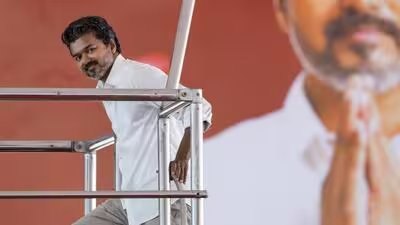
A monthly handout of ₹2,500 for every woman in Tamil Nadu, ₹10,000 for unemployed graduates, a waiver for cooperative crop loans and a ministry of artificial intelligence – Tamil actor Vijay’s Tamilaga Vettri Kazhagam (TVK) made a raft of promises aimed at the southern state’s women, its farmers, and the younger population in its manifesto.
<figure class="art
Those promises appeared to click with Tamil Nadu’s voters.
Counting trends from the Election Commission of India (ECI) showed Vijay’s fledgling outfit leading in 105 of the state’s 234 seats, breaking the decades-old duopoly of the Dravida Munnetra Kazhagam (DMK) and the All India Anna Dravida Munnetra Kazhagam (AIADMK).
Vijay, one of the state’s most popular actors, during the TVK’s election manifesto launch, said the document was based on the principles of the Tamil text Thirukkuralby Thiruvalluvar – aram(virtue), porul(wealth), and inbam(joy), qualities he called essential facets of politics and administration.
“TVK has adopted honest administration as its ideology. Even our party’s first election manifesto is an assurance of honesty. We will not mislead like (incumbent Tamil Nadu chief minister) Stalin. We are not making a hurried manifesto filled with empty promises to the people,” Vijay said on April 16, when he launched the document.
The 95-page manifesto focussed squarely on welfare, from handouts to loans.
For women, the TVK promised ₹2,500 a month to women heads of families aged up to 60, six free LPG cylinders a year, a separate state government department to ensure their security and special women’s courts.
It also promised a sovereign gold coin and a silk saree for every bride. Mothers, it said, will get a gold ring for the newborn. For girls up to Class 12, their mothers or guardians will receive ₹15,000 a year to reduce school dropouts. For women self-help groups, the party promised a single financial handout of up to ₹5 lakh.
For students between Class 12 and the PhD level, the party has promised collateral-free loans of up to ₹20 lakh and a ‘transparent’ timeline for all recruits in Tamil Nadu government. It also vowed a monthly unemployment allowance of ₹4,000 for graduates and ₹2,500 for diploma holders.
Vijay’s party also promised to generate income, even as it assured that it would cushion the unemployed and upskill workers.
It said graduates getting skill-training will get ₹10,000 a month and ITI diploma holders would get ₹8,000.
The party has promised to employ half a million young people at the village level as part of the “CM People Service Associate” programme, a job that will earn them ₹18,000 a month.
The manifesto also urged and incentivised firms to hire locals.
Companies that employ 75% locals for their staff will get 2.5% GST subsidy and 5% rebate on electricity charges.
A significant chunk of the manifesto is dedicated to farmers.
The party promised a cooperative farm loan waiver for those who own up to five acres of land and 50% waiver for those who own more than five acres. A legally guaranteed minimum support price of ₹3,500 for paddy and ₹4,500 per quintal for sugarcane. It promised to introduce a cultivator rights card which would be used to give ₹10,000 to tenant cultivators and farm labourers.
The actor also promised a Citizen Privilege Card for each family to be able to avail the bouquet of the party’s promised government schemes as well as the implementation of a “Right to Service Act”, which will codify and mandate the timely delivery of all government services.
Citizens would be able to submit petitions directly to the state legislative assembly, of which 500,000 responses will be taken up for discussion and with 10,000 signatures will get “mandatory” government response.
Vijay also promised to consider restoring the Old Pension Scheme – a consistent demand among workers in the southern state – and said all temporary employees who completed five years will be regularised and the implementation of a transparent transfer policy.
For police personnel, he promised to increase the basic salary from ₹18,000 to ₹25,000, as well as the addition of a ₹1,000 “high-stress allowance”.