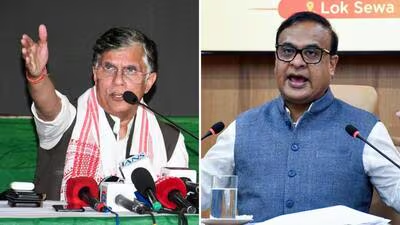
The Congress on Friday urged Assam chief minister Himanta Biswa Sarma to reconsider his stand in the case against party spokesperson Pawan Khera after the Supreme Court granted Khera protection from arrest, and observed that the allegations appeared politically motivated and influenced by political rivalry.
<figure class="art
Addressing a press conference at the Congress headquarters in New Delhi along with party general secretary Jairam Ramesh, senior advocate Abhishek Manu Singhvi, who represented Khera in the Supreme Court, said Sarma could “genuinely elevate himself” by expressing regret over the arrest proceedings.
“I would, with folded hands, request the hon’ble chief minister, perhaps the caretaker chief minister after two more days when the verdict comes, that irrespective of the outcome on Monday, does he not wish to genuinely consider his stand as reflected in the judgement?” Singhvi said.
Khera had accused Sarma’s wife, Riniki Bhuyan Sharma, of possessing multiple foreign passports and undisclosed assets in the United States. Following the allegations, he was booked under charges of forgery, cheating and criminal defamation.
Earlier in the day, the Supreme Court granted Khera relief after he challenged the April 24 Gauhati high court order denying him anticipatory bail. A bench of justices JK Maheshwari and Atul S Chandurkar noted that the dispute appeared to carry political overtones.
Responding to Singhvi on social media platform X, Sarma said the Supreme Court had granted interim protection and that he respected the order, adding that the Assam Police would continue its investigation in accordance with law and place all facts before the competent court.
“I don’t need lessons on democracy, public discourse or decency from anyone, especially from Abhishek Manu Singhvi… The real issue here pertains to a woman — who has nothing to do with politics — but has her character assassinated on national television using forged documents from other countries… I am confident the courts will take note of this, sooner or later and the guilty will be punished for his brazen act of maligning a woman’s character using false documents to influence electoral outcomes… And let me be clear, this is just the beginning, not the end,” Sarma said on X.
Singhvi said many of the statements made by Sarma during the controversy were “unrepeatable, unprintable, unstatable”, adding that even the solicitor general did not defend them before the apex court despite their being in the public domain.
He said the case reaffirmed that the judiciary remains the “ultimate bedrock of hope” when citizens’ personal liberty is at stake.
“The proceedings were a journey of steadfastness and continued faith in getting justice,” he said.
Singhvi further argued that arrest should be the “last resort” in matters involving reputational allegations, particularly where custodial interrogation was unnecessary.
He said Khera did not meet the “triple test” that could justify arrest, such as being a flight risk, being unavailable for questioning, or being capable of tampering with evidence.
“The only object of arrest and custodial interrogation, especially in a political, adversarial context, can be humiliation, harassment, and scoring a political point,” Singhvi said.
He added that nine of the 11 sections invoked against Khera were bailable offences and said the Supreme Court had upheld the presumption of innocence where arrest was speculative.
“Every section, which in a hurry could be thought of, was thrown against him,” Singhvi said.
He also referred to an April 7 order of a judicial magistrate, saying the court had then recorded reasons describing the claim for Khera’s arrest as “speculative, without foundation and fanciful”.
“I, with humility and without any condescension, would say that this truly debases our democracy. It makes us no different from the constitutional wrecks and ruins which we find in our neighbourhood,” Singhvi added.